24/7 operations management at power plants
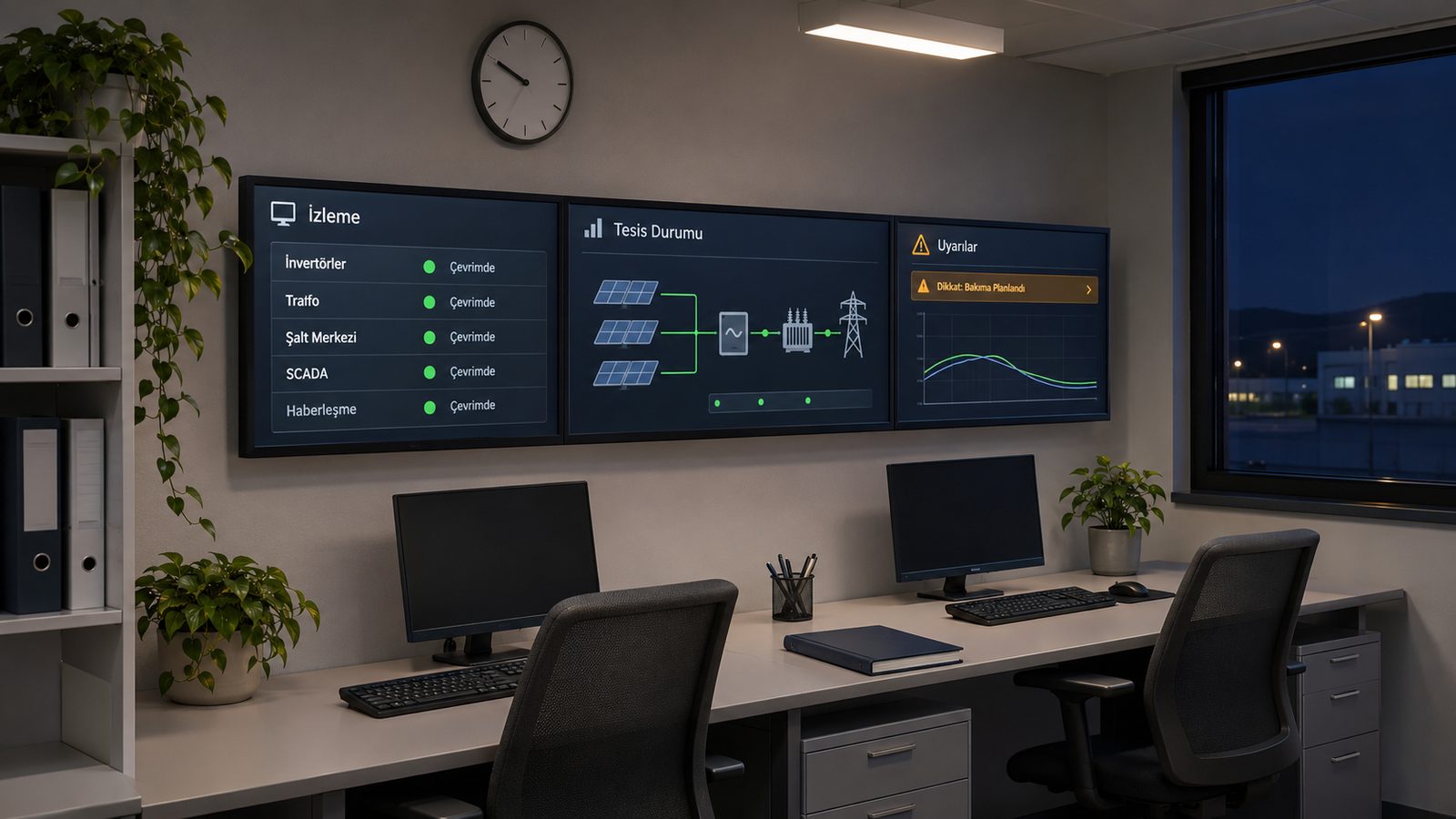
At DBE Energy, we provide central monitoring services seven days a week, 24 hours a day, to ensure the operational continuity of solar power plants.
A solar power plant often operates far from residential areas, spread across large tracts of land and largely unmanned. Being able to see what is happening at these facilities in real time is a prerequisite for responding to potential problems in time. Our operations management approach, which combines central monitoring with regional field teams, focuses on keeping the plants generating without interruption.
What uninterrupted monitoring means
Solar power plants generate only in daylight; this may give the impression that monitoring is also only needed during the day. However, many systems at a plant continue to operate at night. Transformers and MV equipment remain energized, security and communication systems keep running, and events on the grid can affect the facility at any hour of the day.
Monitoring that runs seven days a week, 24 hours a day therefore prevents a problem that arises at night from going unnoticed until morning. When a communication outage or equipment alarm detected at night can be addressed before generation starts the next day, the plant is ready to operate as soon as the sun rises. Weekends and public holidays are no exception to this monitoring.
Another dimension of uninterrupted monitoring is continuity during generation hours. Even a brief outage, especially around midday when irradiation is high, can cause a noticeable loss in daily generation. Spotting the problem the moment it occurs is the most effective way to keep this loss limited. On days when cloudy and clear weather alternate frequently, continuous monitoring becomes even more important for distinguishing whether fluctuations in generation are natural or caused by a fault.
The role of the central monitoring team
Central monitoring is based on bringing together data collected from on-site equipment at a single point. At solar power plants, this data generally comes from inverters, string-level measurements, energy meters, MV and LV equipment and on-site meteorological sensors. Monitoring and data acquisition systems transmit this data continuously and present the monitoring team with a complete picture.
The monitoring team's job is not just to watch screens. Alarms from the system must be interpreted correctly, and a genuine fault must be distinguished from a temporary fluctuation or a sensor-related error. For example, a drop in an inverter's output may be the natural result of cloudy weather, or it may be a sign of an equipment-related problem. Evaluating irradiation data together with generation data makes it possible to make this distinction.
Beyond real-time alarms, monitoring data also forms the basis for evaluating the plant's overall performance. Comparing the energy the plant generates with the energy it is expected to generate under current irradiation conditions is one of the fundamental approaches to performance evaluation. Expressed in the sector through indicators such as the performance ratio, this comparison shows how efficiently the plant is operating independent of weather conditions and makes gradual performance losses visible.
The central structure also makes it possible to track multiple facilities simultaneously and with a consistent method. Seeing similar problems encountered at different plants from a single point makes it easier to spot recurring fault types and share experience across facilities.
From alarm to field
Faults and operational disruptions at facilities tracked by our central monitoring team are managed in coordination with our regional engineer and technician teams. Turning an alarm into an on-site intervention begins with assessing the nature and urgency of the problem. This assessment determines whether the problem can be resolved remotely or needs to be handled on site.
Some problems encountered at solar power plants can be resolved remotely. Communication-related outages, situations that can be fixed by restarting equipment, or software warnings can be addressed without the need to go to the site. Such interventions both save time and allow field teams to focus on work that genuinely requires physical intervention.
In situations requiring on-site intervention, the information gathered by the central monitoring team guides the field team. Knowing in which equipment, at which point and with which symptoms the fault has occurred helps the team go to the site with the right equipment and spare parts. This way, the intervention can begin by focusing directly on the solution rather than on searching for the problem on site.
Completing the intervention is also part of the process. After the field team's work, central monitoring shows whether the equipment has come back online and whether generation has returned to the expected level. When the cause of the fault, the action taken and the parts replaced are recorded, this information is added to the facility's history and helps decisions be made faster in similar situations.
On-site intervention with regional teams
No matter how advanced remote monitoring becomes, replacing a circuit breaker, repairing a damaged cable or checking a transformer connection still requires someone on site. Our regional engineering and technician teams form the backbone of this on-site response capability.
Positioning teams regionally shortens the distance to the plants. Because solar power plants are often built on large plots of land far from city centers, travel time to the site can make up a significant share of the total response time. Teams based close to the region cut this time and help plants get back to generating sooner.
Another advantage of the regional structure is that teams come to know the facilities they work at closely over time. A team that knows a plant's layout, equipment configuration, site conditions and fault history can diagnose problems faster. Know-how on how local conditions such as dust, humidity or heat affect equipment also builds up through field experience.
Occupational safety is another key part of coordination in field work. Before any work on medium-voltage equipment or DC circuits, power must be safely cut off and the equipment concerned taken out of service, then brought back online in a controlled way once the work is complete. This requires clear, continuous communication between central monitoring and the field team.
Continuity of generation
By combining central operations management with on-site technical response capability, we support continuity of power generation and facility performance. Central monitoring and field teams complement each other: monitoring spots the problem, the field team fixes it, and the result of the fix is again verified through monitoring.
Generation lost at a solar power plant is largely a loss that cannot be recovered. The energy an inverter fails to produce while it is down during sunny hours cannot be made up later. That is why what really determines plant performance is how quickly a fault is noticed and how quickly it is resolved. Shortening every step between detection and response means reducing the total loss.
Continuity is not limited to responding quickly to faults. Trends drawn from monitoring data can also carry signs of problems that have not yet turned into faults. Addressing a string whose performance declines over time, rising equipment temperatures or increasingly frequent alerts as part of planned maintenance helps prevent unexpected downtime.
Operations management for facility owners
For plant owners and investors, 24/7 operations management means the assurance that the facility is under watch at all times. Rather than waiting for the owner to notice a problem with their own resources, having an experienced team take on this responsibility lightens the owner's operational burden. For investors with multiple plants in different regions, tracking all facilities from a single center also provides a consistent view of the operation as a whole.
Transparency matters just as much as response capability in operations management. Keeping regular records of faults, interventions and plant performance enables facility owners to track the condition of their plant and base their maintenance and investment decisions on this information.
With our central monitoring team and our regional engineering and technician teams, we continue to ensure the operational continuity of solar power plants and to support facility performance through round-the-clock monitoring, seven days a week, 24 hours a day.