We completed the installation of a DC fast charging station at Tunapark Residences
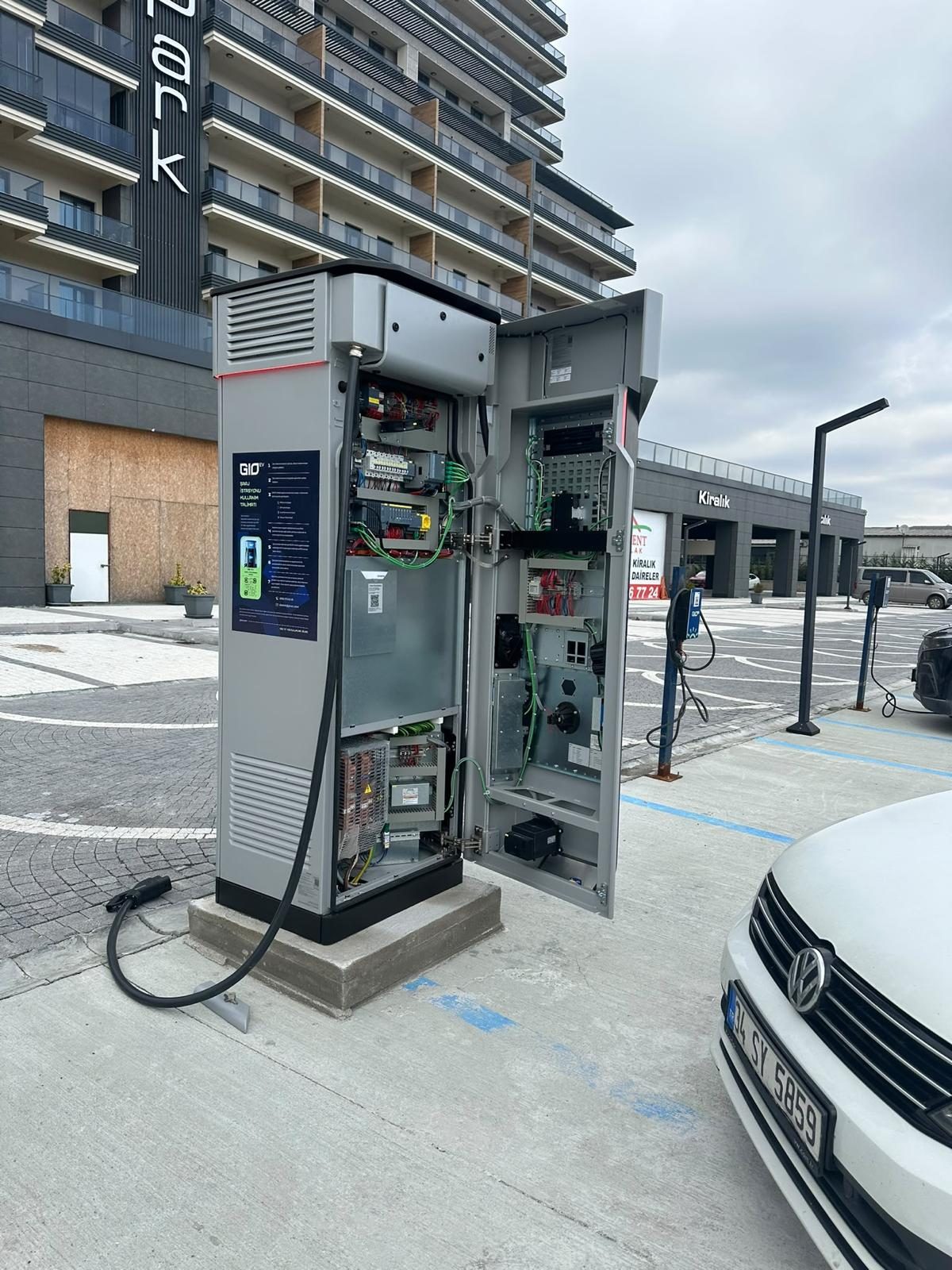
At DBE Energy, we have completed the installation and commissioning of a Siemens SICHARGE D DC fast charging station with 300 kW output power at the Tunapark residential complex in Büyükçekmece, İstanbul, for the GIO EV charging network. The new station complements the AC charging infrastructure already serving the complex, giving EV drivers an option to recharge in much less time.
Charging infrastructure in residential areas plays a decisive role in making EV use part of everyday life. For a driver who knows they can safely charge their vehicle right next to where they live, the decision to switch to an electric vehicle becomes much easier. In this article, we detail the technical features of the station at Tunapark, the commissioning process and the operating model.
Station features
With the DC unit added to the 3 AC charging units that have served the complex since 2024, fast charging capability at Tunapark has expanded. The station has 2 CCS2 tethered charging points. Siemens' SICHARGE D is a charging unit developed for high-power DC charging applications; with 300 kW output power, the station falls into the high-power class of fast charging infrastructure. Together with the existing AC units, Tunapark becomes a charging location that can meet both long-duration and fast charging needs.
CCS2, the European version of the CCS (Combined Charging System) family, is the standard DC charging socket used in most electric vehicles sold in Türkiye and Europe. The standard extends the Type 2 inlet used for AC charging with DC pins added below it, combining AC and DC charging in a single inlet on the vehicle. As a result, the vast majority of vehicles of different makes and models can use the station without an additional adapter.
A tethered charging point means that the charging cable is permanently attached to the station, so drivers do not need to carry a separate cable. Because high-power DC charging involves high currents, these cables are designed together with the station for safe and efficient energy transfer. After parking, users can plug in the connector and start the session via the app to begin charging.
Offering AC and DC charging together
The key difference between AC and DC charging is where the electricity from the grid is converted to direct current for the battery. In AC charging, alternating current is converted by the on-board charger inside the vehicle, so charging speed is limited by the capacity of that on-board charger. In DC charging, the conversion takes place inside the station and energy is delivered directly to the battery, making charging at much higher power possible.
Having both technologies in one residential complex accommodates different usage habits. For a driver who parks in the evening and leaves the car charging until morning, an AC unit is often sufficient, while for a user who needs to get back on the road after a short break during the day or who leaves charging to the last minute, the DC unit offers a clear time advantage.
This setup also contributes to more balanced use of the charging points in the complex. Vehicles parked for long periods can use the AC units, while short-term and urgent needs can be met at the DC station. Residents thus have a flexible infrastructure that lets them choose the charging method best suited to their daily routines.
Factors that determine actual charging speed
The 300 kW output power refers to the maximum power the station can deliver. The power a vehicle actually receives during a charging session varies with the maximum DC charging power the vehicle can accept and with the battery's state of charge and temperature. Vehicles that can accept high power make greater use of the station's capacity, while vehicles with lower DC charging capacity can also charge safely at the same station within their own limits.
EV batteries generally charge at higher power at low states of charge; as the battery approaches full, the vehicle gradually reduces charging power to protect the cells. This is why fast charging is most effective when the battery needs to be brought to a usable level in a short time.
Battery temperature is another important variable affecting charging speed. In cold weather, charging power may be limited until the battery reaches a suitable operating temperature; many current electric vehicles offer a preconditioning feature that brings the battery to the right temperature before fast charging. When these conditions are met, a high-power DC station gives the user a significant saving in charging time.
The terms kW and kWh, frequently seen at charging stations, also mean different things. kW indicates the power delivered at a given moment, while kWh indicates the total amount of energy delivered to the battery. The duration of a charging session depends on the relationship between the energy to be delivered to the battery and the average power supplied over the session.
Commissioning and service
Once installation was complete, the station was connected to our central monitoring system on July 9, 2026. The central monitoring connection marks the stage at which a charging station goes from being merely a physically installed piece of equipment to a service point that can be monitored remotely. Through this connection, the station's operating status, charging sessions and potential alerts can be tracked centrally.
On November 15–17, 2026, our teams carried out service work on the station's SIM card and modem connection. Charging stations often communicate with the central system over a mobile data connection. This connection forms the basic infrastructure that allows users to start charging via the app, session data to be transmitted and the station to be monitored remotely.
A disruption in the communication infrastructure can directly affect the user experience, even if the station's electrical hardware is working flawlessly. That is why components such as the SIM card and modem need to be handled with as much care as the charging unit's power electronics. The service work carried out is likewise a step toward keeping the station's communication with the central system running smoothly.
The role of charging infrastructure in residential complexes
A large share of EV users' charging needs is met where the vehicle stays parked the longest, namely around home and the workplace. This makes residential complexes as critical a link as public stations in the expansion of charging infrastructure. A driver with access to charging where they live can plan daily travel without depending on finding a charging station. Charging stops being a task that requires a separate stop and becomes a natural part of the daily routine.
In Büyükçekmece, on the western side of İstanbul, fast charging that can be done quickly before a trip or on the way back means significant time flexibility for a driver who regularly travels to different parts of the city. Being able to top up the battery quickly before leaving home makes it easier to plan a long day.
Charging infrastructure in residential complexes also adds value by preparing living spaces for the future. As EV use becomes more widespread, living spaces that offer adequate charging become more attractive to residents. The DC station added alongside the AC units at Tunapark stands out as a concrete infrastructure step toward this transformation.
Operation and maintenance
The station's operation, maintenance and 24/7 remote monitoring are carried out by DBE Energy teams. EV drivers can use the station via the GIO EV app. In this division of roles, GIO EV serves as the charging app and network through which drivers find the station and start charging, while DBE Energy handles the station's on-site installation, commissioning and technical continuity behind the scenes.
24/7 remote monitoring means that changes in the station's operating status can be seen at any hour of the day. Remote monitoring infrastructure generally allows some issues to be diagnosed without a site visit and, where on-site intervention is required, enables teams to be dispatched with the right information.
At charging points in residential complexes, reliability is especially important because users plan their days around this infrastructure. Having the station up and running before leaving for work in the morning or when returning home in the evening is one of the key factors that make EV ownership easier. With our DC station at Tunapark, we continue to offer GIO EV users a reliable fast charging experience.