We completed the installation of a fast charging station at Özdilekpark Nilüfer Mall
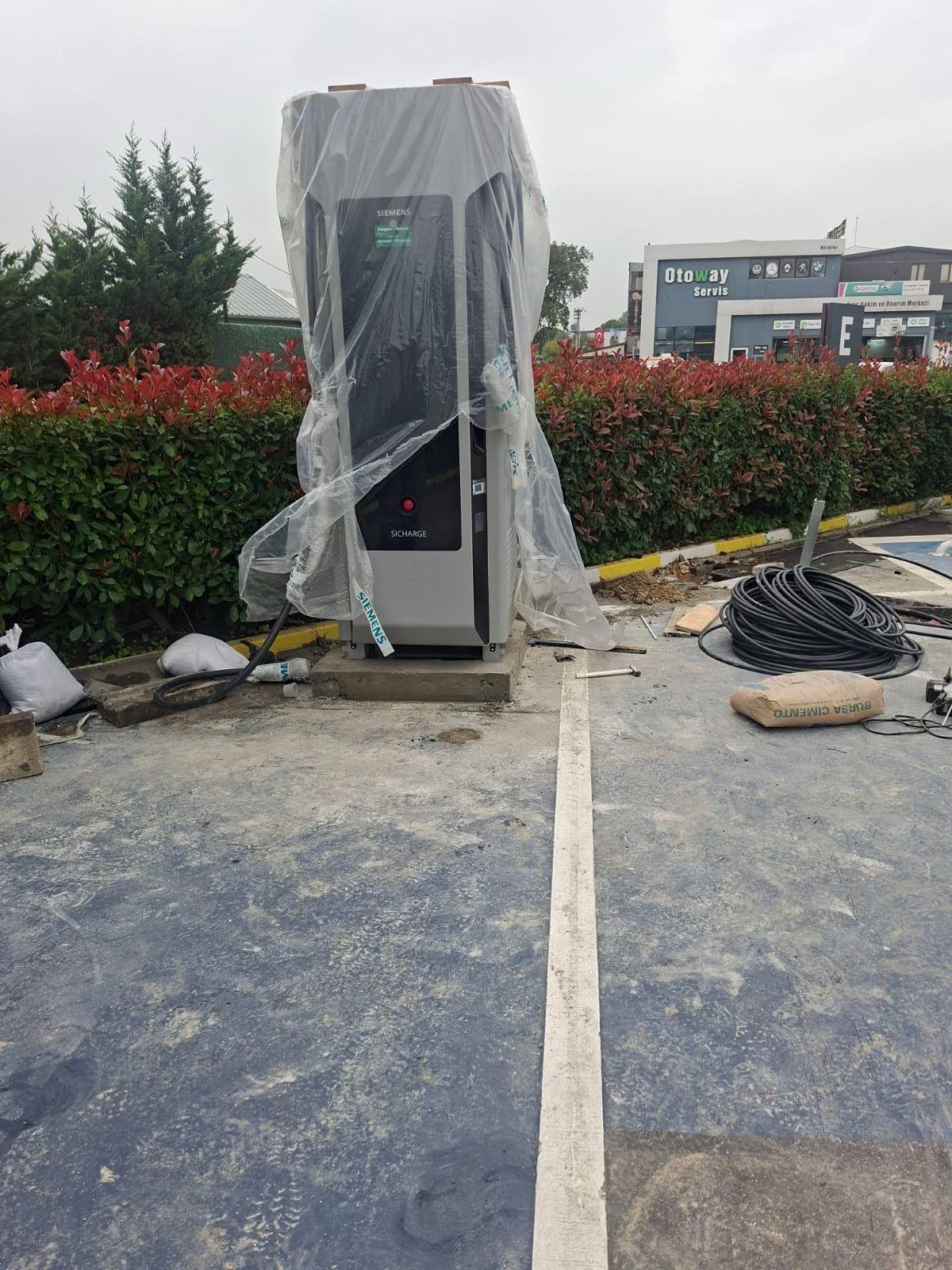
At DBE Energy, we have completed the installation and commissioning of a Siemens SICHARGE D DC fast charging station with 300 kW output power for the GIO EV charging network at Özdilekpark Nilüfer AVM in Nilüfer, Bursa.
The new station offers EV drivers visiting the shopping mall high-power charging while their vehicles are parked. At this location, where we handle the entire process from installation and commissioning to operation and maintenance, drivers access the station through the GIO EV app while the continuity of the infrastructure is our responsibility. Below, we describe the station's technical features, the commissioning stages and how day-to-day operation works.
Charging that matches your shopping time
Shopping malls are one of the most natural meeting points for EV charging. A visit to a mall naturally takes a certain amount of time; while visitors shop, run errands or simply spend time there, their vehicles wait in the parking lot. Charging the vehicle during this time largely eliminates the need for drivers to set aside separate time for charging. When they finish shopping and return to the parking lot, drivers can find their vehicles ready to continue on their way.
This pattern of use is especially important for drivers who do not have charging at home or at work. EV owners who live in apartment buildings and cannot install a charger in their own parking space need public charge points. A fast charging station at a shopping mall they visit regularly offers these drivers a practical solution that can become part of their weekly routine.
For the shopping mall, too, charging is a service that rounds out the visitor experience. When planning where to go, EV drivers may favor locations with charging, which can make a charging station a reason for choosing a mall. Located at a shopping mall in Nilüfer, the station is well positioned to serve both district residents and drivers coming to the mall from other parts of the city.
Siemens SICHARGE D and 300 kW output power
The station uses Siemens' SICHARGE D DC fast charger. Its 300 kW output power places it in the high-power class of public charging infrastructure. The key difference between DC fast charging and alternating current (AC) charging lies in how energy is delivered to the vehicle. In AC charging, the alternating current from the grid is converted into direct current by the vehicle's onboard charger, and the capacity of this charger limits the charging speed. In DC charging, the conversion takes place inside the station, and direct current is delivered straight to the vehicle's battery.
This design bypasses the limitation of the vehicle's onboard charger, making much higher-power charging possible. However, 300 kW is the maximum output power the station can deliver; other factors also determine the power at which a vehicle actually charges. Every EV has a maximum DC charging power it can accept, and the station delivers power without exceeding this limit, communicating with the vehicle continuously. The battery's state of charge and temperature also directly affect charging speed.
In EVs, charging power is generally high while the battery is relatively empty and gradually decreases as the battery fills up. This behavior results from the charging curve designed by vehicle manufacturers to protect battery life. As a result, the advantage of a high-power station is most evident in vehicles that can accept high power and at low battery charge levels. High output power keeps the headroom ready on the station side so that vehicles of different models can each fast charge up to their own limit.
Tethered CCS2 charge points
The station has 2 tethered CCS2 charge points. CCS (Combined Charging System) is a charging standard that combines the connector design used for alternating current charging with additional pins for direct current. The version known as CCS2 is widely used for DC fast charging in EVs sold in Europe and Türkiye. Thanks to this common standard, vehicles from different brands can charge at the same station.
Tethered charge points mean the cable is permanently attached to the station. Drivers don't need to carry a cable; after parking, they simply plug the connector into the vehicle and start charging. Because of the current they carry, DC charging cables that deliver high power are made of specially designed, durable components. That is why supplying the cable with the station is common practice in the industry for DC fast charging stations.
Having more than one charge point makes it easier for drivers to access the station at busy times at shopping malls, such as weekends and evenings. Because cables and connectors are the parts of the station that come into direct contact with users and are used most often, they are also among the components that require particular attention during operation.
The commissioning process
Following installation, the station was connected to our central monitoring system on June 18, 2026. The first charging session took place on November 5, 2026. These dates mark important milestones between a charging station's physical presence on site and the start of its service to drivers.
Commissioning a high-power DC charging station is more than just putting the unit in place. In the industry, this process generally includes preparing the grid connection, checking the electrical protection and grounding arrangement, energizing the unit and setting up the communication infrastructure. In addition, the station's integration with the charge management software and the app that users will access must be completed.
Connecting the station to the central monitoring system is one of the critical links in this chain. From the moment the connection is established, whether the station is online, the status information it reports and any error notifications become visible remotely. Because the station at Özdilekpark Nilüfer AVM was added to the monitoring system before its first charging session, it carried out its first charge on infrastructure that could be tracked remotely.
The first charging session, the moment the station delivered energy to a real vehicle under real conditions of use, was the step that crowned the commissioning process. With this stage, the station became available to EV drivers as part of the GIO EV charging network.
Operation, maintenance and remote monitoring
The station's operation, maintenance and 24/7 remote monitoring are carried out by DBE Energy teams. The value of a charging station is measured not only on the day it is installed but also by being in working order whenever drivers need it on every day that follows. That is why the operation period after installation is the real area of responsibility, lasting throughout the station's lifetime.
Remote monitoring allows the station's status to be tracked continuously. When an error or connection problem arises, it can be detected through the monitoring system without waiting for a driver to report it. While some software issues at charging stations can be resolved remotely, in cases requiring on-site work the technical team can be dispatched with prior knowledge of the nature of the problem. This approach helps shorten the time it takes to resolve a fault.
On the maintenance side, high-power DC chargers contain components that require regular inspection. For devices in this class, scheduled maintenance generally includes inspecting the physical condition of cables and connectors, checking the cooling systems and air filters that protect the power electronics, and reviewing electrical connections and protective devices. In an environment with constant vehicle traffic, such as a shopping mall parking lot, regular checks of the area around the station and the user-facing surfaces are also part of safe use.
Using the station with the GIO EV app
EV drivers can use the station through the GIO EV app. As an EV charging app and charging network, GIO EV is where interaction between drivers and the station takes place. Behind the scenes, we at DBE Energy carry out the station's installation, commissioning, operation and maintenance.
For drivers, this division of labor means a simple experience. While a driver reaches the station through the app and charges, the monitoring, maintenance and fault response processes that keep the station technically ready run in the background. The quality of the user experience depends largely on how consistently these background processes are carried out.
With the station at Özdilekpark Nilüfer AVM, a new high-power point has been added to the GIO EV charging network in Bursa. At this location, which brings shopping time and charging time together, we continue our operation and maintenance work to ensure the station serves reliably under 24/7 remote monitoring.