GIOEV met with investors at the CFA 2023 London event
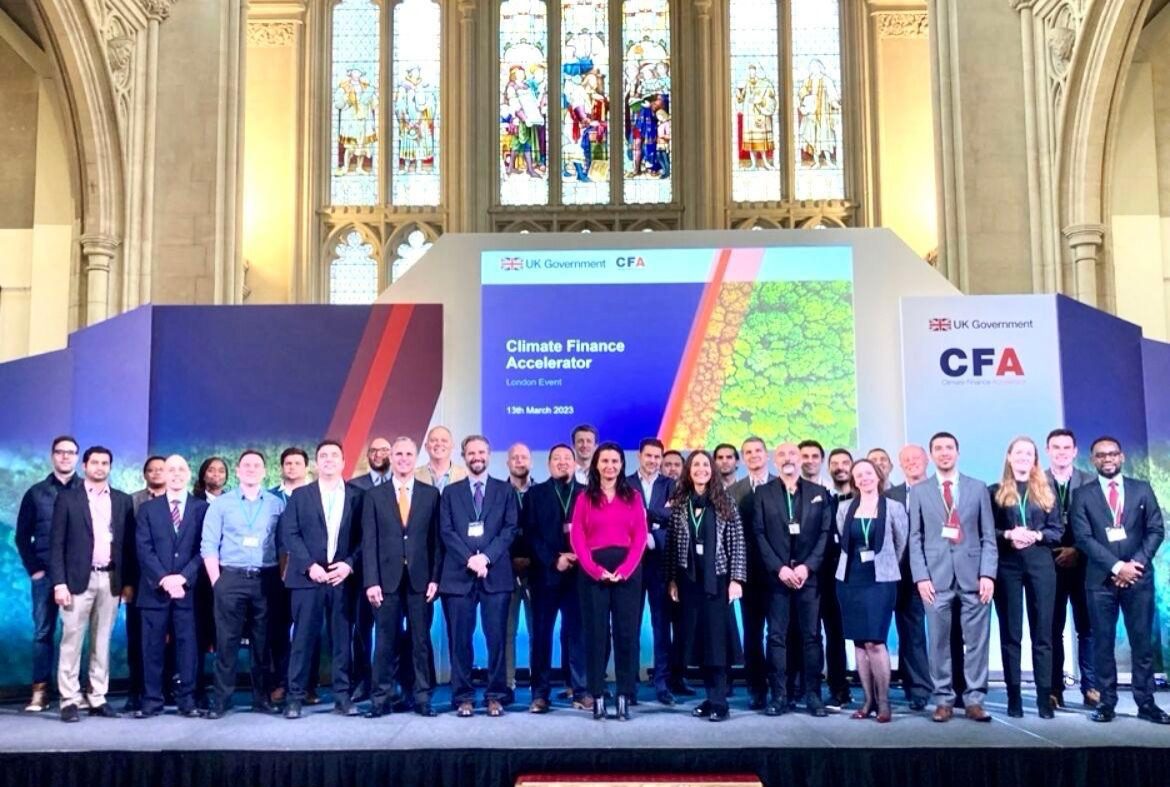
DBE Holding subsidiary GIOEV, which builds Türkiye's fastest EV charging stations, took part in the 2023 London event of the Climate Finance Accelerator (CFA) Program. At the investor meeting held in the second week of March at the initiative of the UK government, GIOEV met with financiers including BNP Paribas, Citibank, Helios, Standard Bank, the UK International Investment Office and the World Bank.
The event was part of a program that connects projects reducing carbon emissions with international sources of finance. For GIOEV, the meeting offered an opportunity to present its business model, which combines EV charging infrastructure with renewable energy generation, to leading representatives of the global financial world. The event coincided with a period when the company's growth plans in Türkiye and new talks in the Middle East were also on the agenda.
Selected from among 773 projects
The event brought together 15 companies from Türkiye, Mexico, South Africa, Colombia and Pakistan. The companies were selected from 773 projects submitted from 5 countries as the ventures with the greatest potential to contribute to climate transformation. At the event, where projects in renewable energy, transportation, waste conversion, housing, water and food production were presented, a panel led by PwC and sustainability workshops were also held.
The size of the application pool shows that the companies attending the London meeting stood out from strong competition. When evaluating a climate project, international financiers generally consider its contribution to emission reduction, its financial sustainability and its feasibility together. Going through such a selection process allows companies to appear before financiers with greater visibility.
The wide range of projects presented at the event, from renewable energy to water and food production, shows that climate transformation is not limited to a single sector. With its model that addresses transportation and renewable energy together, GIOEV is positioned at one of the intersections of this range.
Climate Finance Accelerator Program
Operating since 2017, the CFA brings together project developers and financiers to support the financing of projects that reduce carbon emissions; to date, it has provided $167 million in financing to developing countries.
Climate finance refers to funding for projects that reduce greenhouse gas emissions or support adaptation to the effects of climate change. Despite their high potential for impact, climate projects in developing countries may face difficulties accessing finance. Project developers' ability to prepare financial models, risk analyses and impact measurements in the form investors expect is seen as one of the main thresholds to overcome in this process.
Programs such as the CFA bring project developers and financiers to the same table to fill this gap. These meetings also make it possible to assess how different sources of finance, such as development institutions and private banks, can contribute to the same project. This approach, in which public and development funds are used alongside private capital, is also known in the sector as blended finance. The fact that the program is run at the initiative of the UK government reflects the view that public support can act as a catalyst in channeling private capital into climate projects.
Meetings with financiers
The financiers GIOEV met in London included BNP Paribas, Citibank, Helios, Standard Bank, the UK International Investment Office and the World Bank. This list spans a wide range, from globally operating banks to investment firms and leading institutions of international development finance.
For an infrastructure company, meeting different types of financiers means being able to evaluate different financing options at the same time. Development finance institutions generally offer long-term funding focused on climate impact, while commercial banks may stand out with instruments such as project finance and corporate loans. This diversity is particularly important for infrastructure requiring high upfront investment, such as EV charging stations and solar power plants. Such assets, which generate long-term revenue, provide suitable ground for financing structures that can bring together financiers with different maturity and risk expectations.
Organized at the initiative of the UK government, the event also reflects the role of London, one of the world's financial centers, in climate finance.
A model with few examples worldwide
At the event, it was highlighted that GIOEV operates in transportation through its EV charging stations and in renewable energy through the solar power plants that power these stations. It was stated that this model, of which there are few examples worldwide, would deliver a 0.26 percent annual improvement in Türkiye's carbon emissions once fully operational.
The climate impact of electric vehicles is closely tied to how the electricity they use is generated. Although a vehicle charged with electricity generated from fossil fuels produces no tailpipe emissions, it can indirectly cause emissions. Powering charging stations with solar power plants aims to meet the energy vehicles use from renewable sources, making emission reduction in transportation more holistic.
Combining transportation and energy generation in the same business model also offers a notable structure from a climate finance perspective. By addressing emission reduction on both the transportation and electricity generation sides, this model can offer investors a comprehensive framework for measuring and reporting climate impact.
The role of charging infrastructure in electric mobility
The spread of electric vehicles depends as much on the availability and reliability of charging infrastructure as on advances in vehicle technology. When deciding to switch to an electric vehicle, drivers primarily consider where and how quickly they can charge their vehicles in daily use and on long journeys.
This is why high-power charging stations play a role in reducing the practical barriers to electric mobility, especially on intercity routes and at busy locations. Shorter charging times bring EV use closer to a familiar experience for drivers accustomed to internal combustion vehicles.
Investments in charging infrastructure also mean early positioning in a market where usage will intensify as the number of vehicles grows. From a climate finance perspective, these investments are seen as infrastructure projects that can contribute directly to reducing transportation-related emissions.
New talks in the Middle East
GIOEV has also begun talks with investors in the Middle East, particularly in the UAE, Saudi Arabia and Qatar. These talks are exploring both developing new projects in the region and securing investment from funds.
The Gulf countries are showing interest in renewable energy and electric mobility in line with their goals of diversifying their economies beyond oil and natural gas. Home to powerful investment funds, the region is an attractive geography for electric mobility companies, both for project development and as a source of capital. The talks in the region therefore complement GIOEV's investor contacts in London.
Considering both developing new projects and securing investment from funds shows that GIOEV sees the Middle East as both a market and a source of financing. Continuing the contacts that began with international financiers in London with investors in the Gulf reflects the company's approach of spreading its search for financing across different geographies.
Growth plan
GIOEV, which is preparing to expand its charging network to 15 stations by the end of March, plans to reach 50 stations with 300 kW output power by the end of the summer with an investment of TL 200 million.
300 kW output power puts the stations in the high-power class of DC fast charging infrastructure. Stations at this power level allow vehicles that can accept high charging power to charge in a short time. The power a vehicle actually receives varies according to its technical specifications and the condition of the battery.
Expanding a network of high-power stations also brings a significant capital requirement. In addition to the charging units, components such as the grid connection, site preparation and the solar power plants that power the stations determine the scope of the investment. The CFA meeting in London and the talks in the Middle East stand out as investor contacts that coincided with these growth targets.