Green energy to power 136,000 households
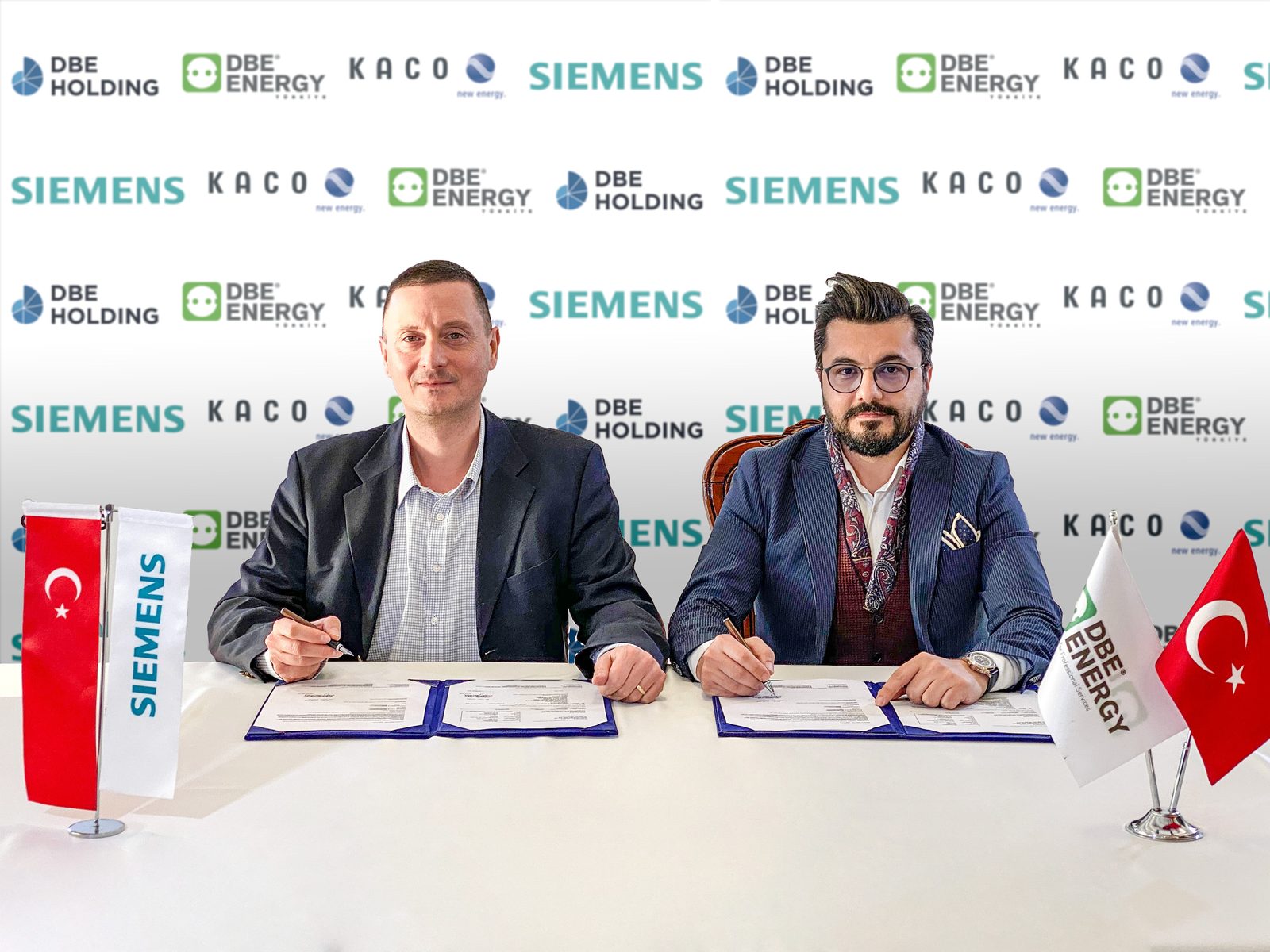
DBE Energy, a DBE Holding company, has signed a 200 MW partnership with Siemens subsidiary KACO New Energy for use in solar power plant investments in Türkiye and abroad.
The signing ceremony was attended by DBE Holding Chairman of the Board Mehmet Taha Pınar, Siemens – KACO Global Sales Manager Nedret Ünlü and Siemens Sales Manager Saim Hacıağaoğlu. The partnership covers the inverters to be used in the plant projects and is expected to deliver a significant environmental benefit once the projects are completed.
Scope of the agreement
Under the agreement, DBE Energy will use the blueplanet 165.0 TL3 inverter series of KACO New Energy GmbH, wholly owned by Siemens, in 200 MW of solar power plant projects. Mehmet Taha Pınar noted that this series is among the products with the most technologically advanced components.
Because the partnership covers projects both in Türkiye and abroad, DBE Energy can run its solar power plant investments in different markets on the same equipment infrastructure. A supply relationship with an international manufacturer can also provide continuity in equipment supply and technical support for projects in different countries. Since grid connection rules and technical requirements can vary from country to country, equipment compliance with these requirements also becomes important throughout the project process.
The 200 MW refers to the installed capacity of the plants. While installed capacity indicates the maximum power a plant can produce at any instant under ideal conditions, the total energy a plant generates over the year depends on solar irradiation in its region, system design and the efficiency of the equipment used. That is why equipment selection is among the factors that determine how much of the installed capacity is turned into generation.
The inverter's role in the plant
Inverters are among the equipment often described as the heart of a solar power plant. Solar panels produce direct current (DC), while the grid and consumers run on alternating current (AC). By converting the direct current from the panels into grid-compatible alternating current, inverters are the prerequisite for feeding the plant's output into the grid.
The inverter's job is not limited to converting current. Modern inverters continuously track the operating point at which panels deliver maximum power under changing irradiation and temperature conditions. Known as maximum power point tracking (MPPT), this function directly affects how much energy is harvested from the same panels. Inverters also synchronize with the grid, disconnect for protection when there is an anomaly on the grid, and generate the data needed to monitor the plant. Compliance with the technical rules set by grid operators is also among the inverter's responsibilities; responses to voltage and frequency fluctuations are largely managed by the inverter's control software.
Conversion efficiency is also a decisive criterion in inverter selection. Every loss in the inverter means energy produced by the panels is lost before it reaches the grid. Over the plant's operating life, these small differences add up and can have a noticeable effect on total generation. That is why inverters are among the components given the most attention in plant design.
Inverters also hold a central place in plant operation and maintenance. The data they produce is one of the main sources of information for monitoring the plant and detecting faults, while an inverter going offline means that all panels connected to it stop generating. The reliability of inverters is therefore among the factors that directly determine plant availability.
Advantages of equipment standardization
Using the same inverter series across 200 MW of projects means equipment standardization across the plant portfolio. Having the same equipment at different plants makes operation and maintenance considerably easier. When technical teams specialize in a single product family, faults can be diagnosed faster and interventions carried out more consistently.
Standardization also simplifies spare parts management. While an equipment fleet made up of different brands and models requires a separate spare parts stock for each product, a common product series reduces this need. For monitoring systems, too, equipment that uses the same data structure makes it easier to track plant performance on a comparable basis.
Since solar power plants are investments operated for many years, the impact of equipment selection is not limited to the installation phase. A long-term partnership with a reliable manufacturer also serves as a guarantee of technical support and product continuity throughout the plants' operating life.
A direct partnership with the equipment manufacturer can also make it easier for technical teams to access product training, software updates and manufacturer support. Since software updates, parameter settings and possible warranty processes for inverters may arise over the plants' operating life, having a sound line of communication with the manufacturer is an operational advantage.
Power for 136,000 households from renewable sources
Once all the projects are in place, the 200 MW SPP investment will meet the electricity needs of 136,000 households from renewable energy sources. Household equivalence is a way of expressing a plant's output that makes it easier to grasp in concrete terms. Such calculations generally compare a plant's expected annual generation with the annual electricity consumption of an average household.
Installed capacity expressed in megawatts is a technical figure that can remain abstract for the general public. The number of households, on the other hand, makes the investment's everyday meaning clearer: it means the electricity used in homes, from lighting and household appliances to heating and cooling and electronic devices, is supplied by energy generated from the sun.
A growing share of electricity from renewable sources is also important for reducing dependence on imported energy and making use of domestic resources. As a source with no fuel cost and no emissions during generation, solar energy is among the leading technologies of this transition.
Lower carbon emissions
According to Pınar, the investment will prevent 312,000 tons of CO₂ emissions, the equivalent of 24 million trees given back to nature. Avoided-emission calculations are generally based on the assumption that electricity generated from the sun replaces the same amount of grid electricity; the greater the share of fossil fuels in grid generation, the larger the avoided emissions.
Tree equivalence, in turn, is an indicator that makes the natural counterpart of avoided emissions tangible. Trees absorb carbon dioxide from the atmosphere as they grow; by calculating how many trees would absorb the carbon equivalent to the avoided emissions, the environmental impact is brought to a more relatable scale.
Because solar power plants produce no direct emissions during operation, the environmental benefit recurs every year the plant is in operation. This means the investment's impact is not a one-off but a contribution that keeps accumulating over the plant's lifetime.
Environmental indicators like these make the impact of renewable energy investments measurable for investors, financial institutions and the public. In sustainability reporting and green finance processes, indicators such as avoided emissions are among the most frequently used criteria for assessing a project's environmental contribution.
Contribution to the economy and the sector
Siemens – KACO Global Sales Manager Nedret Ünlü expressed his hope that the agreement would be productive for both parties, while Siemens Sales Manager Saim Hacıağaoğlu said the partnership would make a significant contribution to both the national economy and the sector.
The economic impact of large-scale solar investments goes beyond the electricity the plants will generate. Project development, engineering, installation and operation and maintenance processes create jobs and technical know-how in the sector. Partnerships between investors and international equipment manufacturers can also pave the way for knowledge and technology transfer. Relationships built with local suppliers and service providers during the construction and operation phases also carry the investment's economic impact beyond the plant site.
From the sector's perspective, long-term partnerships between renewable energy investors and equipment manufacturers increase predictability in project planning. Securing equipment supply in advance helps manage project schedules and budgets more soundly. In this respect, the 200 MW partnership between DBE Energy and KACO New Energy is an important step for solar power plant investments both in Türkiye and abroad.