Major International Partnership from a Turkish Company
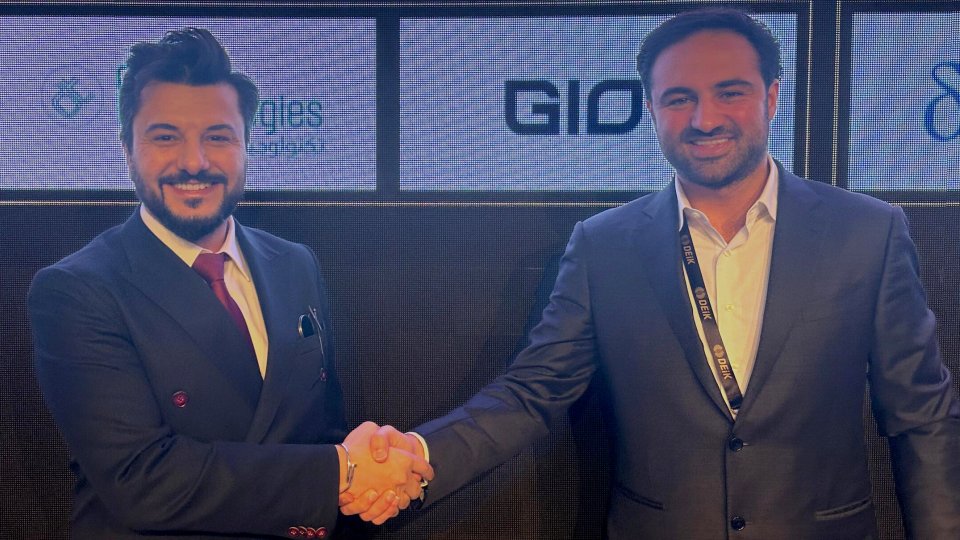
DBE Holding subsidiary GIOEV (GIO Elektrikli Araç Şarj İstasyonları A.Ş.) signed a memorandum of understanding with Saudi Arabia-based Desert Technologies. The signing took place at the Türkiye-Saudi Arabia Investment and Business Forum, attended by Minister of Treasury and Finance Mehmet Şimşek and Minister of Culture and Tourism Mehmet Nuri Ersoy.
The partnership, which aims to expand and operate EV charging networks in the Middle East, Europe and Africa, stands out for its broad scope, spanning everything from infrastructure and software to marketing and energy management. The agreement also drew attention for being signed at a forum addressing economic relations between the two countries.
Charging network partnership across three continents
The memorandum of understanding was signed by DBE Holding Chairman of the Board Mehmet Taha Pınar and Desert Technologies CEO Khaled Sharbatly. The parties aim to work together to expand and operate EV charging networks in the Middle East, Europe and Africa.
The scope of the partnership is broad. It covers the infrastructure and construction processes, operation, software and marketing of charging stations, as well as the stations' energy management.
In business, a memorandum of understanding is used as a framework document setting out the parties' shared goals and the areas in which they wish to cooperate. Such documents set the direction of the partnership, while detailed terms, responsibilities and implementation steps are usually clarified through the work the parties carry out in later stages. A memorandum of understanding is therefore regarded as the starting point of a long-term partnership.
The layers of a charging network
The topics covered by the memorandum also summarize how an EV charging network works. Infrastructure and construction processes cover preparing the locations where stations will be installed, making electrical connections and placing charging units on site. This stage forms the physical foundation of the network.
Operation concerns keeping stations accessible and working for users after installation; maintenance, fault tracking and field management are part of this. The software layer is the digital face of the network: it includes the apps that let users find stations, start charging and pay, as well as the management systems that allow stations to be monitored remotely.
Marketing aims to make the charging network known to and preferred by users. Energy management plays a decisive role, especially at high-power charging stations. Balancing the power stations draw from the grid, managing peak hours and, where appropriate, integrating with renewable energy sources matter for both cost and grid security.
Within the group structure, GIOEV represents the user-facing side as the EV charging app and charging network, while the installation, commissioning, operation and maintenance of the stations are carried out by DBE Energy behind the scenes. The broad scope defined in the memorandum provides a partnership framework in which these layers of the charging network can be addressed together on an international scale.
About Desert Technologies
Desert Technologies is a Saudi Arabia-based company specializing in smart infrastructure investments. It has ventures in renewable energy, digital energy, off-grid energy, technology and mobility, and stands out as a strong player in the Middle East, Africa and emerging Asian markets.
The company invests in development projects through Capton Energy, its joint venture with Siemens Financial Services, and aims to establish the Middle East's first ESG fund. Khaled Sharbatly is also the CEO of Capton Energy. With a budget of approximately $500 million, Capton Energy is described as a project development and financing platform focused on solar energy infrastructure investments.
The company's areas of activity are also directly related to the subject of the memorandum. Off-grid energy solutions aim to provide access to energy where electrical infrastructure is limited, while digital energy refers to managing generation, consumption and grid data through software and automation. The inclusion of energy management in the scope of the charging network partnership shows how closely these areas are related.
ESG is an abbreviation for environmental, social and governance criteria and describes an approach that takes these criteria into account in investment decisions, not just financial returns. Funds created with this approach play an important role in channeling resources to sustainability-focused projects.
Electric mobility in different markets
The Middle East, Europe and Africa bring together markets at different stages of the transition to electric mobility. In every market, the spread of EV use depends as much on the accessibility of charging infrastructure as on the vehicles themselves. Whether users can charge with confidence in the city and on intercity journeys depends on the network's coverage and the uninterrupted operation of its stations.
Building charging networks in different markets requires taking into account each region's grid infrastructure, climate conditions, user habits and regulatory framework. A partnership with a company that holds a strong position in regional markets is therefore valuable for growing the network in the right locations and with the right models.
The spread of charging infrastructure is measured not only by the number of stations but also by their reliability. For users, it matters just as much that a station is working when they reach it as that it appears on the map. That is why operation and maintenance are among the topics that directly determine the user experience in charging networks.
Planning energy sources and charging infrastructure together is another prominent approach. Integrating renewable sources such as solar energy with charging stations can increase the environmental benefit of electric vehicles while also helping to manage the load on the grid. From this perspective, Desert Technologies' ventures in renewable and off-grid energy could add a new dimension to the partnership.
Aiming for high added value
Mehmet Taha Pınar described the memorandum as a new step toward the holding's vision of becoming a global company. Pınar recalled that they had recently signed an EPC memorandum with Siemens in Dubai for potential sustainability projects in the Middle East, and described the agreement with Desert Technologies as another important milestone on this path.
Pınar also emphasized that, as a holding preparing for the future, they would continue to deliver innovative work. He stated that their goals are to develop energy generation and management technologies, offer users high value-added models and lead the way in next-generation renewable energy.
EPC refers to the turnkey project model covering the engineering, procurement and construction phases. In this model, the contractor undertakes the process from project design to equipment procurement and on-site installation. The Siemens memorandum Pınar mentioned and the Desert Technologies agreement show that the holding is approaching opportunities in the region from different angles: one focuses on the implementation side of sustainability projects, the other on electric mobility infrastructure.
In the energy sector, added value refers to the additional benefit a product or service provides to the user. In EV charging networks, this benefit comes from a combination of factors such as accessible stations, uninterrupted service, easy-to-use digital interfaces and efficient energy management. The high value-added models Pınar emphasized can also be linked to this holistic approach to service.
Background of the forum
The Türkiye-Saudi Arabia Investment and Business Forum was held in mid-February 2024, hosted by the Ministry of Treasury and Finance and organized by the Presidency of the Republic of Türkiye Investment Office and DEİK. At the forum, 6 memoranda of understanding and 21 business agreements were signed between the two countries. According to figures reported in the press, trade volume between the two countries reached $6.8 billion in 2023.
Such forums stand out as platforms where investment opportunities are explored by bringing together public institutions and the private sector. The participation of ministers reflects the significance of the agreements signed for economic relations between the two countries. For companies, such settings provide visibility and credibility for entering new markets and building international partnerships.
The signing of the memorandum between GIOEV and Desert Technologies at such a forum also shows that electric mobility is among the areas on the economic agenda between the two countries. Sitting at the intersection of energy, infrastructure and technology and open to international cooperation, charging networks offer suitable ground for such partnerships.
How the agreements signed at the forum translate into action on the ground depends on the work the parties carry out in the coming period. While memoranda of understanding provide a guiding framework in this process, concrete projects take shape as the parties put their shared goals into practice.