Our operation and maintenance capacity reached 210 MW
At DBE Energy, we continue to grow our operation and maintenance services for solar power plants. Our service capacity, which stood at approximately 100 MW in 2025, reached 210 MW in 2026; our target for 2027 is to take this capacity above 300 MW.
Operation and maintenance is a long-term service area that begins after a solar power plant is commissioned and continues throughout the plant's economic life. How much energy a plant generates depends not only on the quality of installation, but also on how regularly and correctly the site is attended to during the operating period. In this article, we look at what our capacity increase means, the scope of the service and our target for the coming period.
From 100 MW to 210 MW
Our service capacity, which stood at approximately 100 MW in 2025, reached 210 MW in 2026. Through the operation, maintenance, monitoring and reporting services we provide to solar power plants operating in different regions of Türkiye, we support investors' energy generation processes.
In operation and maintenance, service capacity refers to the total installed capacity of the plants served. Growth in MW therefore means that the plant infrastructure within the scope of service has expanded to the same extent. In a solar power plant, this infrastructure covers a wide range of equipment, from panels to inverters, and from cabling and combiner boxes to transformers and switchgear.
Every increase in capacity means more equipment to monitor, more generation data to track and more energy to report to the investor. The expansion of the plant portfolio we serve requires us to run our operational processes on a larger scale and with the same care.
The scope of operation and maintenance
Operation and maintenance at solar power plants is generally addressed under the headings of scheduled maintenance, corrective maintenance, monitoring and reporting. Scheduled maintenance covers checking panels, inverters, cables, connection points and protection equipment at set intervals and carrying out the necessary cleaning and adjustments. The aim here is to identify problems before they affect generation.
Corrective maintenance, on the other hand, involves intervening on site when an unexpected problem arises and bringing the equipment back into service. Since an inverter going offline or a connection problem in a panel string means a direct loss of generation until it is resolved, response speed is a decisive criterion in this area.
In addition to scheduled and corrective maintenance, the site infrastructure as a whole also falls within the scope of operation and maintenance. Regular reviews of the mounting structure that carries the panels, the grounding and lightning protection systems, site perimeter security and access roads are among the prerequisites for the plant to operate both safely and efficiently. Monitoring and reporting form the link that connects all of these activities.
The role of monitoring and reporting
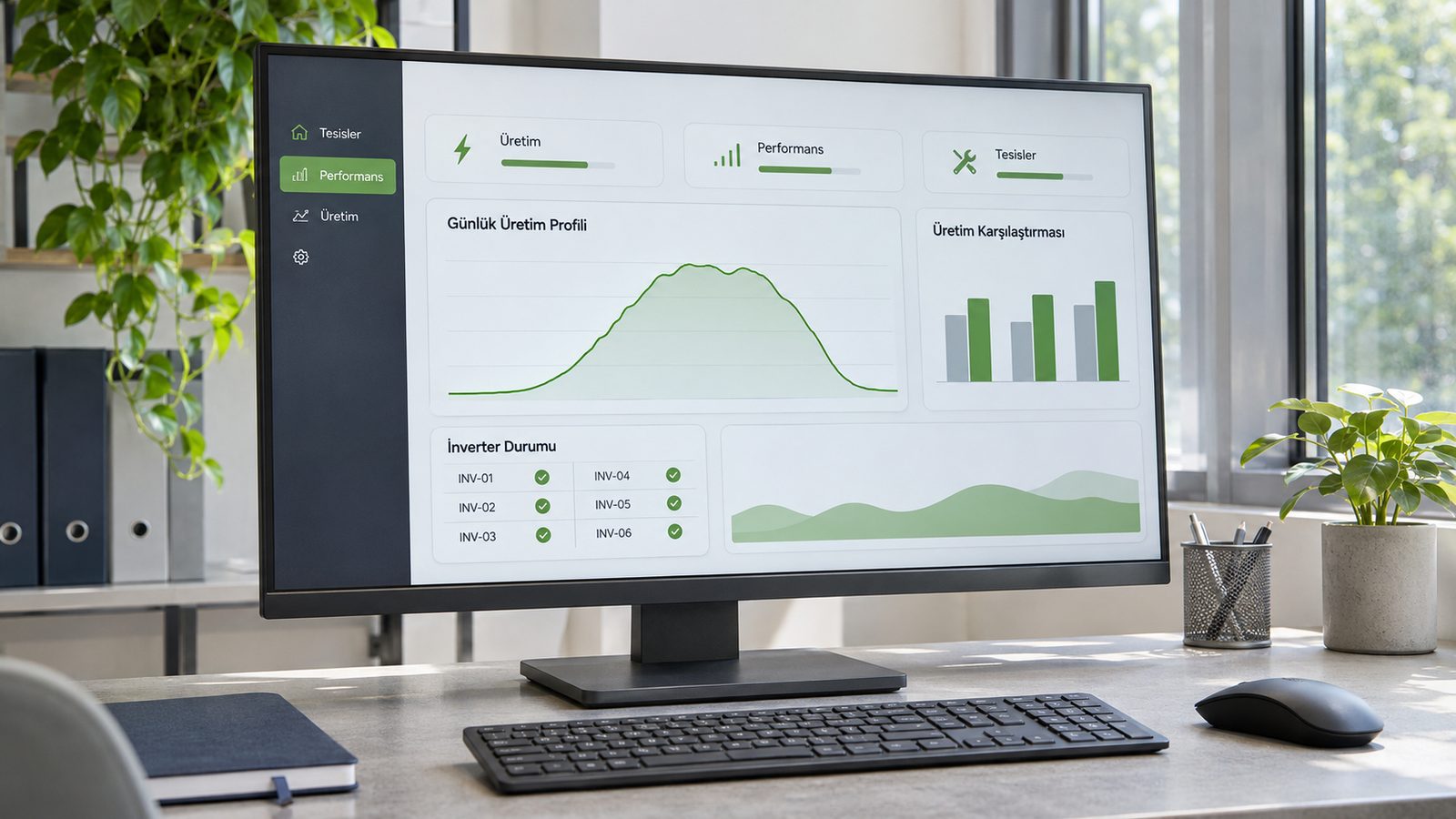
Remote monitoring at solar power plants is carried out by collecting data from inverters and on-site measurement equipment in a central system. This data includes the amount of energy generated, the operating status of the inverters, fault and warning logs, and meteorological measurements such as solar irradiation and temperature.
Evaluating meteorological data together with generation data makes it possible to calculate how much the plant should generate under that day's weather conditions. When the gap between expected and actual generation widens, the source of the deviation is investigated; the problem may lie in an inverter, a panel string or the grid connection. Indicators such as the performance ratio are also used to show how efficiently the plant is operating, independent of weather conditions.
Reporting turns this data into meaningful information for the investor. When periodic generation figures, faults, response times and maintenance work are brought together in reports, investors can assess the status of their plant without being on site and from a single document.
Different needs in different regions
Serving plants in different regions of Türkiye requires taking into account the unique conditions of each site. Factors such as climate, dust and pollution levels, precipitation patterns, snow load and vegetation directly shape a plant's maintenance needs.
In arid and dusty regions, dirt accumulating on the panel surface can reduce generation by preventing irradiation from reaching the cells; at such sites, cleaning planning comes to the fore. In rainy regions or those with dense vegetation, controlling plants that could shade the panels and site drainage become important. In regions that receive snowfall in winter, the effect of snow accumulation on both the supporting structure and generation is among the issues that need to be monitored.
High temperature is also a factor affecting the efficiency of solar panels; as panel temperature rises, electrical efficiency drops somewhat. Adequate ventilation and cooling in the areas housing inverters and electrical panels is also critical for equipment life. Field experience gained in different geographies makes it possible to tailor operation and maintenance services to the conditions of each plant.
The value of operation and maintenance for investors
For its investor, a solar power plant is a long-term source of income. The predictability of this income depends on the plant's ability to maintain its planned generation level over the years. This is exactly where operation and maintenance services come in: keeping equipment running in good condition, detecting generation losses early and carrying out the necessary interventions on time.
Regular reporting enables investors to monitor their plant remotely. When generation data, fault logs and maintenance work are made visible through reports, it becomes easier to base investment decisions and financial planning on a solid data foundation. For financing institutions and insurers, too, regular maintenance and transparent reporting are among the factors considered when assessing a plant's risk profile.
Equipment life is also an area directly affected by operation and maintenance. Loose connection points, worn cables or cooling problems in inverters can lead to both generation losses and more costly failures if not addressed in time. A preventive approach aims to bring these risks under control before they grow.
The operational strength that comes with scale
Growth in the capacity served also brings economies of scale in operation and maintenance. Experience gained from different plants can help similar equipment and fault types be recognized more quickly and maintenance plans be prepared more accurately.
A larger plant portfolio also requires a holistic perspective on spare parts and materials planning. Since quick access to spare parts when a critical piece of equipment fails directly determines how long the generation loss lasts, a growing portfolio makes a planned approach essential in this area.
As scale grows, standardizing processes also becomes more important. Consistent site inspections, fault logs and reporting formats make it easier both for teams to work efficiently and for investors to compare performance across different periods. Reaching a capacity of 210 MW also brings with it the responsibility of sustaining this operational structure across a broader portfolio.
The 2027 target
Our target for 2027 is to raise our operation and maintenance service capacity above 300 MW, taking our operational strength in the sector even further. This target requires growth to be treated not merely as a capacity increase, but as a process that must be achieved while maintaining service quality. As the portfolio grows, scaling field teams, monitoring infrastructure and reporting processes in step with this growth is decisive for the continuity of service quality.
As solar energy investments continue in Türkiye, the need for operation and maintenance services that keep commissioned plants running efficiently for many years is also increasing. In a market where installed capacity is growing, plants maintaining their performance throughout their economic life remains decisive for the return on investment.
At DBE Energy, we continue to develop our operation, maintenance, monitoring and reporting services together with our growing capacity. Our goal is to be a reliable business partner that supports investors' energy generation processes at every plant we serve.