Sustainable energy generation through planned maintenance
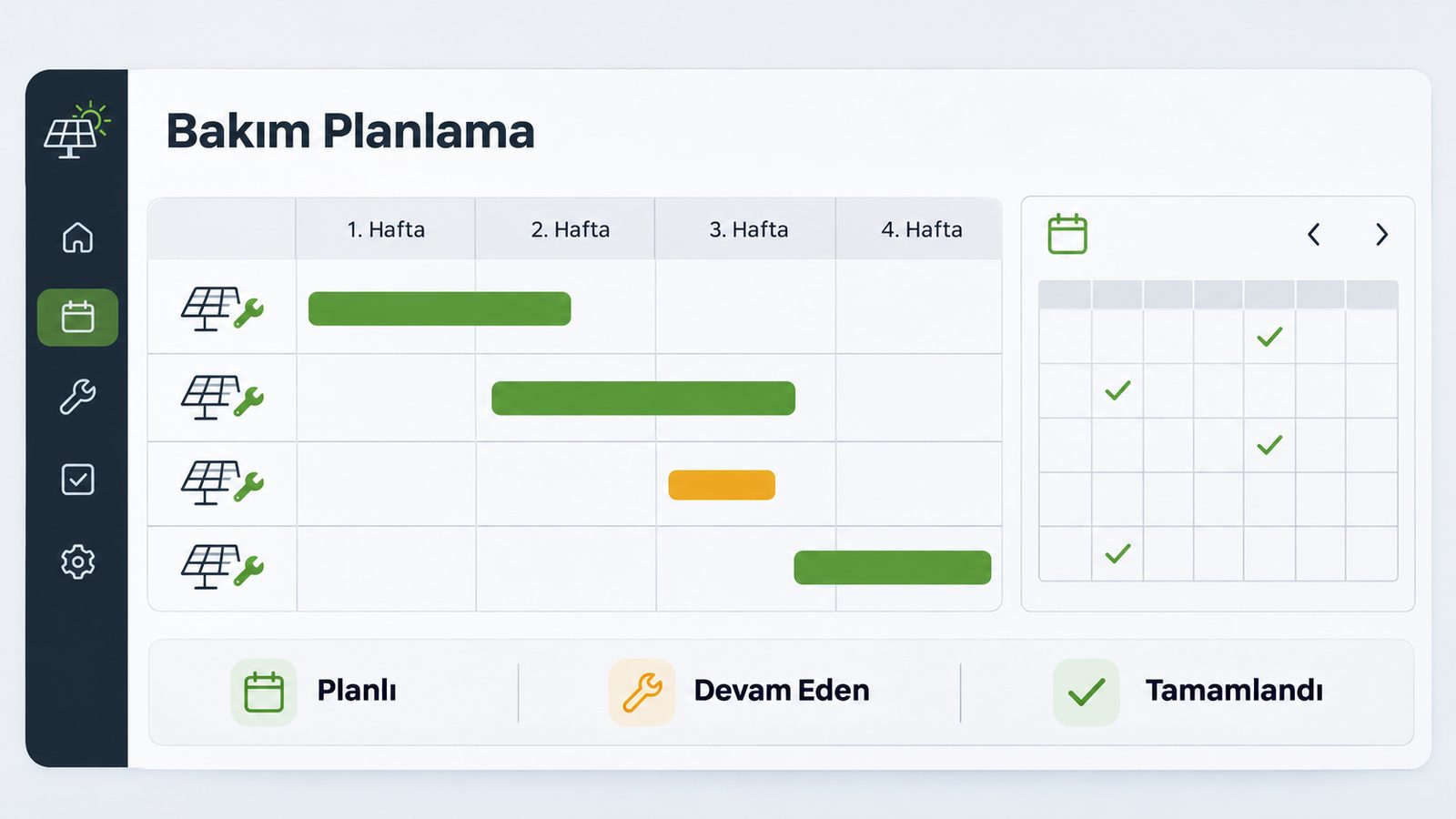
We offer comprehensive planned maintenance services to protect the long-term performance of solar power plants and reduce their operational risks. A plant's ability to deliver its expected generation over its operating life depends as much on how its equipment is monitored and maintained in the years that follow as on the quality of its installation.
Solar power plants are known as long-lived facilities with few moving parts. However, panels, cables, fasteners, inverters, transformers and mounting structures operate outdoors for years under the effects of temperature changes, wind, precipitation, dust and humidity. These conditions call for a regular, planned maintenance approach so that small problems do not turn into major generation losses over time.
Facility-specific maintenance programs
We create monthly, quarterly, semi-annual and annual maintenance programs in line with investors' needs and the technical characteristics of each facility. Every plant has a unique structure defined by its installed capacity, the equipment used, the climate conditions of its region and its installation type. That is why a maintenance program should be shaped not by a single template but by the facility's actual needs.
For example, the maintenance requirements of a rooftop plant and a ground-mounted plant differ. While access, occupational safety and the condition of the roof structure come to the fore in rooftop installations, ground-mounted plants require more attention to vegetation control, perimeter security and cable routes spread over a large area. At dusty sites or sites close to industrial zones, panel surfaces can become soiled more quickly.
Expectations can also differ on the investor side. For some investors, the priority is minimizing generation losses, while others focus on extending equipment life or keeping complete records required for warranty and insurance processes. Designing the maintenance schedule around these priorities ensures that the service creates tangible value for the facility owner. Reporting maintenance results also enables facility owners to closely follow the condition of their plant.
The logic behind maintenance intervals
Different maintenance intervals are designed to track equipment conditions that change at different rates. In general industry practice, frequent checks focus mostly on observing the overall condition of the site, visual inspections and detecting problems that can be spotted quickly. Breaks or cracks on panel surfaces, loose connections, damaged cables or unexpected inverter alerts are among the key items in these checks.
Maintenance carried out at longer intervals generally includes more comprehensive measurements and tests. Torque checks of electrical connections, insulation measurements, assessment of the grounding system, functional testing of protection equipment and checks at transformer substations can be addressed in this scope. Annual maintenance offers an opportunity to assess the plant as a whole and set maintenance priorities for the next period.
Combining monthly, quarterly, semi-annual and annual programs ensures that each check is carried out at its own frequency. This both prevents unnecessary interventions and ensures that critical equipment is not overlooked.
Inverters are among the equipment addressed separately in maintenance programs. Electronic components, cooling fans, filters and software versions are items that affect the long-term stable operation of inverters. Reflecting manufacturer recommendations in the maintenance schedule is important for both device lifespan and warranty terms.
Electrical and mechanical checks
Our maintenance processes extend from electrical and mechanical checks to performance measurements. On the electrical side, panels, string connections, cables, connectors, combiner boxes, inverters, transformers and protection devices make up the plant's energy generation chain. A problem in any link of this chain can take part or all of the plant out of generation.
For electrical checks, methods such as string current and voltage measurements, insulation resistance tests and thermal imaging are widely used in the industry. Thermal imaging helps detect areas on panels and at connection points that heat up more than normal, known as hot spots. These hot spots are often seen as a sign of problems such as cell damage, shading, soiling or a weak connection.
On the mechanical side, the soundness of the mounting structure, the condition of fasteners, signs of corrosion and the security of panel mounting are among the items typically checked. Wind load, temperature-driven expansion and ground movement can cause the structure to loosen over time. At plants that use tracking systems, the proper operation of moving mechanisms is also especially important. Mechanical protection of cable trays and cable connections is also among the items monitored for both electrical safety and equipment lifespan.
Performance measurements and data
The clearest way to tell whether a plant is operating properly is to compare actual generation with expected generation. Taking into account conditions such as solar irradiation and ambient and panel temperature, performance measurements show to what extent the plant produces the energy it should under these conditions. Generation that falls short of expectations can be the first sign of a problem not yet noticed on site.
Remote monitoring systems make this comparison continuous. Data collected at inverter and string level makes it possible to quickly see a drop occurring in a specific part of the plant. When combined with on-site inspection of the points flagged by monitoring data, planned maintenance becomes more targeted and effective.
Recording the measurement results obtained during maintenance is also important. Comparison between periods makes it possible to notice slowly progressing deterioration in equipment; declining trends in panel performance or an inverter behaving differently from the others become visible thanks to these records.
The cleanliness of panel surfaces is also directly linked to performance. Dust, pollen, bird droppings or industrial pollution can reduce the light reaching the panel surface and lower generation. Assessing the need for cleaning together with performance data and site observations helps decide when to clean while balancing efficiency and cost.
Identifying faults in advance
Through our maintenance processes, we aim to identify potential faults in advance, protect equipment and reduce losses in energy generation. The key difference between planned maintenance and post-failure intervention is that the problem can be addressed before it turns into lost generation. With post-failure intervention, the plant or part of it may remain offline until the problem is resolved, and this downtime can drag on depending on spare parts availability and site access.
The preventive approach also has a direct impact on equipment lifespan. Spotting a loose connection in time can prevent overheating at that point and the resulting equipment damage. Keeping inverter fans and filters clean helps the device run at the right temperature, reducing the risk of failure.
Reducing operational risks is not limited to generation. Regular inspection of grounding and protection systems is also decisive for the safety of personnel working at the plant and of the surrounding environment. Early detection of overheating and damaged cables that could increase fire risk is among the basic conditions for operating the facility safely.
Planned maintenance also makes spare parts and equipment management easier. Information from maintenance records helps anticipate which equipment is nearing the need for replacement, making it possible to plan for critical parts in advance rather than searching for them at the moment of failure.
Long-term value
Planned maintenance is an approach that preserves the long-term value of a power plant investment. Regular maintenance records can provide an important basis for properly managing equipment warranties, insurance processes and potential transfer or financing assessments. A plant with a documented maintenance history becomes an asset whose technical condition can be presented more transparently.
The age of the plant is also a decisive factor in maintenance planning. In the first years of operation, early detection of issues that may stem from installation takes priority, while in later years, tracking performance declines due to equipment aging and anticipating part replacement needs become more important. Updating maintenance programs in line with the plant's life cycle keeps the focus on the right priorities at every stage.
With maintenance programs shaped by investors' needs and the technical characteristics of each facility, we help solar power plants generate safely, efficiently and sustainably throughout their operating lives.